 How can I help you? How can I help you?
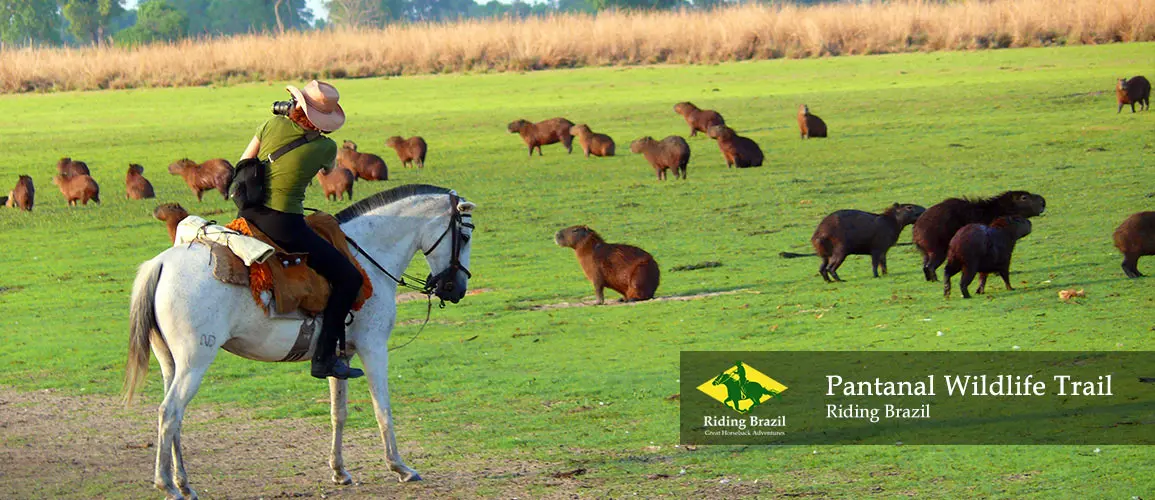
Our Pantanal riding trips were first designed by Peter Rohmer back in 1995 for the genuine rider wanting a genuine experience, different from all other rides anywhere. Peter´s priorities have been and still are to ride at places with no tourism at all or extremely little tourism to prevent loss of authenticity and tradition, as it has unfortunately become obvious at some places in the Pantanal. Peter has taken care however that your Pantanal riding adventure will be an unforgettable experience.
Another equally important requirement was to make sure that the guests are getting involved with the owners and staff of the fazendas and are being treated as members of the family instead of tourist. Our guests not only sit at the same table with the owners for meals or for chats but they also ride out with the vaqueiros, here called peões, to help them with their cattle work. This is awesome and the dream of any rider.
The quality of our horses is unquestionable, can be proven and checked from our guests comments on our webpage. They are obedient, patient but also fast and forward going. We have horses matching with the rider's abilities and experiences.
Pick-up at Campo Grande airport and transfer to the Hotel Vale Verde. After the long journey you have just completed, the rest of the day is free for relaxation. Depending on the time of your arrival, however, if you do still have some energy, you might want to visit a specialized outfitter which we recommend for distinctly Brazilian ranch and horse equipment. They offer whips, hats, boots, saddles, reins, stirrups etc. Sun block and mosquito repellent are also available in the pharmacy next to the hotel. The Vale Verde Hotel is located close to the airport, and to Federal highway that will take you to the Fazenda Nhecolandia. The hotel is not deluxe but is comfortable, and offers all necessary amenities.
Our guide picks you up at 7:30am with a 4x4 vehicle. Estimated time of arrival at the Fazenda Nhecolandia is around 1:30pm. Alternatively, there is also the possibility of taking a private chartered flight into the Pantanal wilderness. The panoramic flight to our Fazenda takes about 60 minutes and offers spectacular views from the low flying plane. Please ask for details.
The Fazenda has a charming atmosphere and offers comfortable accommodation. Your friendly hosts, Doio and Rita, will welcome you and take you to your rooms. You will then have a light lunch, after which you can relax in a gently swinging hammock in the shade of the porch or, if you prefer, in your air-conditioned room. Later that afternoon you will have a short ride through the ranch to enable you to try out the horse you will be riding for the next days and have your first glimpse of the region’s wildlife. The Pantaneiro horses are gorgeous, calm and fast when demanded, suitable both for experienced and novice riders. They are all well trained, surefooted, calm and yet forward going. The saddles are made for comfort and safety.
Back at the guesthouse, you may want to inspect the ranch’s other facilities and surroundings. Afterwards a delicious dinner will await you which you will eat together with your hosts and possibly a few other guests in the dining room.
Fazenda Njecolandia encompasses some 16 thousand hectares and about 10.000 Nelore cattle, an Indian Brahma cross, perfectly adapted to the hot and humid climate of the Pantanal and other tropical and sub-tropical regions In Brazil. The Fazenda is located at the edge of the Vazante Castelo, hosting a great variety of wildlife easily to be observed on the wide and flat savannah bush land. During the stay here we will be riding every day to different locations to observe the wildlife. Nature will release its wonders to us bit by bit, offering fascinating sights every day. The Nhecolândia region offers great riding at all paces on the wide, open land.
These days at Fazenda Nhecolandia start with a Pantaneiro farmers’ breakfast which is so substantial that you may think you are enjoying lunch instead! By the time you finish breakfast the horses are saddled and ready to go. The group will ride out with the peões, the cowboys of the Pantanal, and help rounding up and tending to the calves on the property. The fascinating cattle drives are other activities you will enjoy very much. When riding out with the peões there is a great variety of wildlife to be seen. This includes the American rhea, Nine banded armadillo, Anteater, Peccary, Capybara, and the huge marsh deer. Your guide will also help you seek out troops of Black and Brown howler monkeys which live in the area. The Pantanal is also known for its extraordinary diversity of birdlife. There are enormous flocks of water birds, such as pink spoonbills; several species of herons; Jabiru giant stork, which are also referred to as tuyuyu in this region; Jacana, referred to as cafézinho because of their colour; Southern screamer, Red-legged siriema, Toucan, all three big macaws, including the biggest of all the Hyacinth macaw which come right to the porch. Please ask for a wildlife list when making reservations.
At some point in our stay it may be possible to take a relaxing canoe ride and fish for piranha in a nearby lake. We also recommend having a round of teréré Mate tea with the peões. The peões, mostly descendants from Indigenous people of several tribes of the region encompassing Paraguay and Brazil, are the authentic representatives of the Pantanal. Chatting with them, you will get to know the peculiarities and the history of this region.
On the last night at Nhecolândia ranch, a special dinner is on the menu, traditionally consisting of generous chunks of wild boar or lamb grilled on the open fireplace, washed down with some good Brazilian wines (you did not know that Brazil produces wine?) on the house.
Today the group is set to depart early for a full day of riding fun. The São Luis camp site is the destination. Riding for miles and miles at the edge of the beautiful Vazante Castelo, one cannot help but marvel at the wide-open spaces covered in places with lush native forest. Observe the animals en route or enjoy having a great canter on these lands blessed by nature.
Lunch is delivered by the 4x4 support vehicle which also carries your belongings to the camp site. We have chosen a shaded place for lunch followed by a much-welcomed siesta, as the riding day is a long one.
Our night break is at the São Luis camp site. The camp site is extremely comfortable, with bathrooms, showers, kitchen, refrigerators, ventilators, window screens and staff who look after the guests’ needs. After refreshing drinks, including cold beers, and a good meal, we can hit our hammocks. However, some might prefer to stay awake for some storytelling around the camp fire. Certainly, subjects will include the not so elusive but dangerous jaguar, the gigantic anacondas and the brave horse men who explore this region. From the nearby lake you will hear caimans making terrifying sounds while hunting fish.
The São Luis camp site is part of the Fazenda Primavera, a huge property encompassing some 20.000 ha. .located at the outer edges of the Nhecolandia region not far from the border to Pantanal of Rio Negro. The wide, open and flat land reaches up to the horizon and invites for long canters and gallops. Here we will enjoy a full day of unlimited riding fun and marvel at the naturally formed sweet and saline water lakes, the so called “baias”, and “salinas, feeding places for enormous flocks of water birds feed . The “baias” are also home to caymans, cabiparas and mammals such as jaguar, ocelot, monkey, which are coming her to drink. The stay at São Luis camp site is certainly a highlight of your Pàntanal Wildlife Ride.
Unfortunately it is time to say good-by to the Pantanal and all the folks who made this ride unforgettable. On board a 4x4 vehicle we transfer you to Campo Grande Airport, from where you connect to any chosen destination.
Please ask for itineraries of our 12 days extended Pantanal trail and other interesting extensions such as beach riding, whale watching, botanical discoveries, Amazon River tours and jungle expeditions.
The itinerary of our Pantanal riding tours are subject to changes and may be altered in accordance with conditions during the stay and the ride. The decisions taken by the local team must be adhered to.


Riding Brazil offers farm and ranch stays both for equestrian holidays, and for non-riding vacations. Our trail riding guests may want to stay on after a trail ride for a few more days with their hosts, or to spend some time in the Brazilian countryside, enjoying the authentic rural lifestyle away from the hassle of the big cities.
When staying on our Pantanal ranch, visitors are offered great wildlife observation and outstanding photography opportunities. Guided by the competent and friendly Fazenda staff, clients will explore the natural beauty of the Pantanal on horseback, hiking and jeep tours.

There is also the opportunity to take part in the everyday work of the pantaneiro peões, the Pantanal cowboys. Trailing cattle, learning about the secrets of regional horsemanship, or participating in preparing the delicious food that is produced right there in the fazenda's own facilities, are other experiences that you would not want to miss.
Our ranch in the Pantanal is a 30.000 acre property with some 12.000 head of cattle. It belongs to a traditional family which has been engaged in cattle breeding for four generations.
The Pantaneiro people, who are landowners both of European descent and the peões of Indian-Bolivian ancestry, have a rich heritage of traditions and culture. Our ranch stays are a very special and profound experience, which goes much deeper into Pantanal life and culture than the usual Pantanal tours, and are likely to have a profound emotional effect on the visitor.

| US$ (American Dollars) |
|
Transfer option 1 In: Campo Grande/Fazenda Nhecolandia, on 4x4 SUV, aprox. 6 hrs Out: Camp site / Campo Grande Airport, on 4x4 SUV, aprox. 6 ½ hrs |
|
| 4 Riders | * |
| 3 Riders | * |
| 2 Riders | * |
| Add-on for single room occupancy | * |
| * I will be pleased to inform updated prices upon request. | |
|
Transfer option 2 In: Campo Grande/Fazenda Nhecolandia , private air charter, aprox. 1:15 hrs Out: Camp site / Campo Grande Airport, private air charter, aprox. 1:25hrs |
|
| I will be pleased to inform up dated prices upon request ! | |
| This would give you the advantage of six full and one half riding days. |
| 2026 |
| May 18 | to | May 25 |
| June 15 | to | June 22 |
| July 27 | to | August 03 |
| August 10 | to | August 17 |
| September 7 | to | September 14 |
| October 5 | to | October 12 |
The Pantaneiro horse has been developed as a cattle horse during the last 200 years in the state of Mato Grosso, the Northern Pantanal, to serve on the large farms which, not rare, measured some 150-200 thousand acres. The Pantaneiro or Poconé horses resemble the Crioulo horse from the Southern Brazilian pampas, showing a bit higher members, though. It has adapted through natural selection to the temporary flooded terrain of the Pantanal feeds even with the pasture under water and does not develop hoof diseases. The horses used by the peões (cowboys) to work the extremely agile Nelore cattle, are very alert and enduring even under heavy work load, when temperatures may reach 40 ºC and more. They stem from the famous "Pocone" breed, a crioulo crossbreed, adapted perfectly to the characteristics of the seasonally flooded and dry lands. We offer those horses to the more experienced riders of the group.
Handling and tack of the horses is similar to the Western Style. Crioulo saddles are lighter and covered by 2-3 colourful sheepskin layers for long days riding.
To ensure maximum comfort, experience and fun, and as a diferencial to the normal, our group size is never more than 4 riders. Special groups and families with members up to 6 riders however will be accepted with great pleasure. Special groups and families with members up to 6 riders can also accepted. The owner of the Fazenda will normally ride the trails with you. In addition, you will be accompanied by a a local horse man and a multilingual interpreter and guide, who will provide you with information about the history of the region, its economy and ecology, its politics and religion, and – of course – the role of the horse. He can do so in English, German, French, Spanish and Italian, as required. He also takes care of the organisation of the trip and makes sure everything runs well.
Accommodation is generally in double or single rooms. Hot showers, either en suite or shared, are always available. We generally stay at Fazendas (the Portuguese word for working farms or ranches), which may be simple but are always clean and cosy.
Food consists of a great variety of regional delicacies - and comes in gigantic portions! We also cater for vegetarians on demand. All meals are highlighted by local cuisine, some of the most delicious meat you have ever tasted, home-made breads, beignets and rolls, exotic fruits and vegetables, home-made cheeses, compotes, and cane fudge and caramel sauces. During your trip you will be treated to fish, suckling pig, a BBQ of the hump of the Asian cow, and many other delicacies local to the country and the region.
A good time to visit the Pantanal is from April to September, because it is winter in the southern hemisphere and the temperatures are more pleasant. This is also the best time to view wildlife as the animals concentrate on the fewer ponds and other water sources available. It is also the nesting season for most birds and macaws. July and August are main seasons and reservations, including payments, have to be made well ahead for this period. Please contact for details on July and August dates.
Check out our available extensions for this ride:

 DEU
DEU